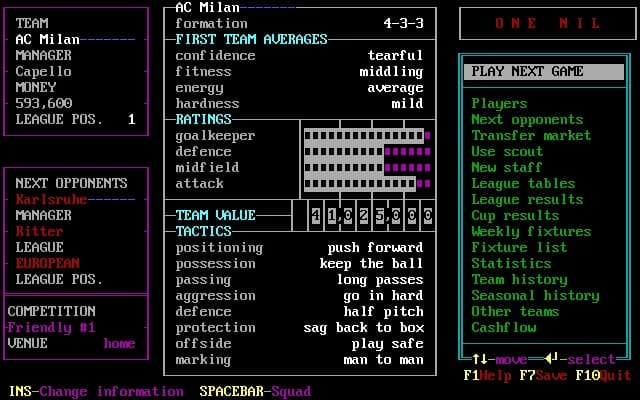
The title screen calls One-Nil advanced management for football addicts, and the help file is written by people who plainly are: it explains its sacking rules with a reference to Alex Smith winning the Scottish Cup with St Mirren and losing his job soon afterwards. The squads are real ones of 1992, with Spink, Staunton, McGrath and Saunders at Aston Villa.
What it does differently
There is no manager's contract. Only poor league form gets you sacked, and cup wins are ignored. Get sacked and the game carries on, with you out of work until another club offers a job, which one always does.
The super league is reached through Europe rather than the table: reach the final of a European competition and the club goes up. Youth players arrive on trial for one to four games at a nominal cost, and the quality your scout turns up depends on your success. Skills change with age, not results, each player peaking for three or four years and goalkeepers late. A squad can run to 40, though the chairman dislikes more than 20 under contract, and a contract also settles whether the player is released for internationals.
Where it shows its age
It is keyboard only and all text: the players are letters and symbols on a drawn pitch. Watching every match is the intended way to play and takes time; R gives the result at once but discards the match statistics. Answering yes to loading a saved game when there is none, then no to trying again, drops you at the DOS prompt; type 1-0 to start over. If injuries leave you short of eleven, the help file's answer is to hire youth players and put them straight in.
Worth playing?
Yes. It has the text-mode match it shares with Goal II, a far deeper squad than The Soccer Game II, and a career in which a sacking is a chapter rather than an ending.