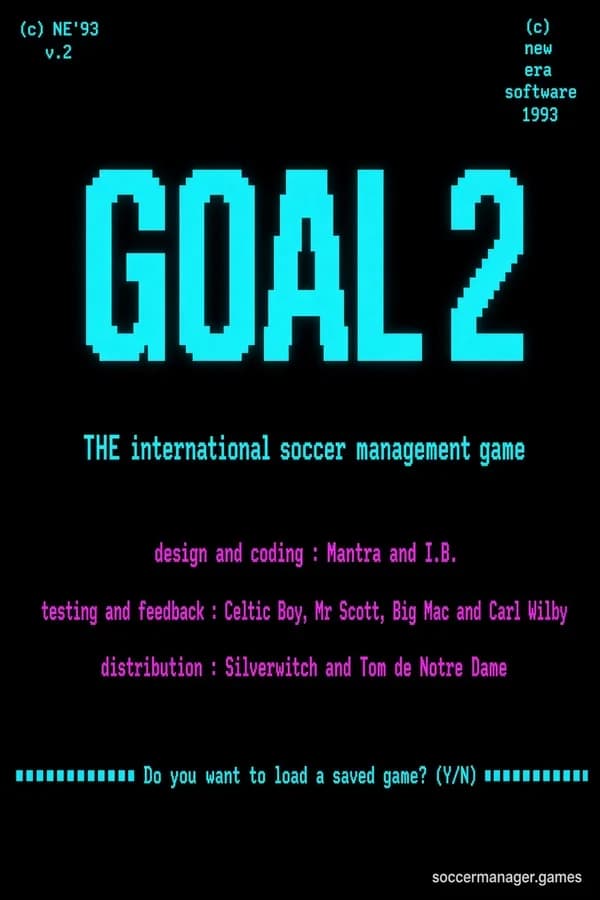
The help file introduces Goal II as coming from the writers of The Soccer Game and One-Nil, and it takes their ideas to national teams with one clever turn: the talent your country produces depends on how you do. The squads are real ones of the period, so England's has Platt, Gascoigne and Shearer in it.
What it does differently
Results are judged against expectation. Beat the sides you are supposed to lose to and better young players begin to appear in your pool; fall short and the men who retire are hard to replace. Confidence works the same way: the help file's example is Germany, expected to beat India by three, losing confidence by winning by two. Nobody is exempt from qualifying, holders and hosts included.
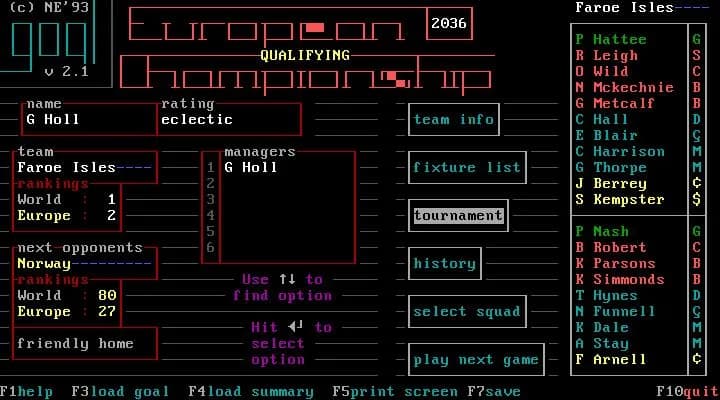
Each man on the pitch is drawn as the symbol for his position, a dollar sign for a striker, a cent sign for a centre forward, a C with a cedilla for central midfield, and the arrow keys change the speed and switch to shirt numbers or smiley faces. Space brings up the last 200 lines of commentary, and goals can be replayed and saved. Feinting, one of twelve skills, is not, the help file is careful to say, the ability to fall over in a dead swoon.
Where it shows its age
It is keyboard only: arrows, Enter, Esc and the function keys. Everything is drawn in text characters, the newspapers included. Watching each game in full takes a while; R jumps to the result but throws away the match statistics. The PC speaker plays Que Sera, which the help file admits is there to drive you round the bend, though the sound can be switched off.
Worth playing?
Yes. A small country nursed through a few four-year cycles is the long save this game is built for. Goal 94 is the same game updated for the American World Cup, and One-Nil Soccer Manager uses the same text-mode match for clubs.