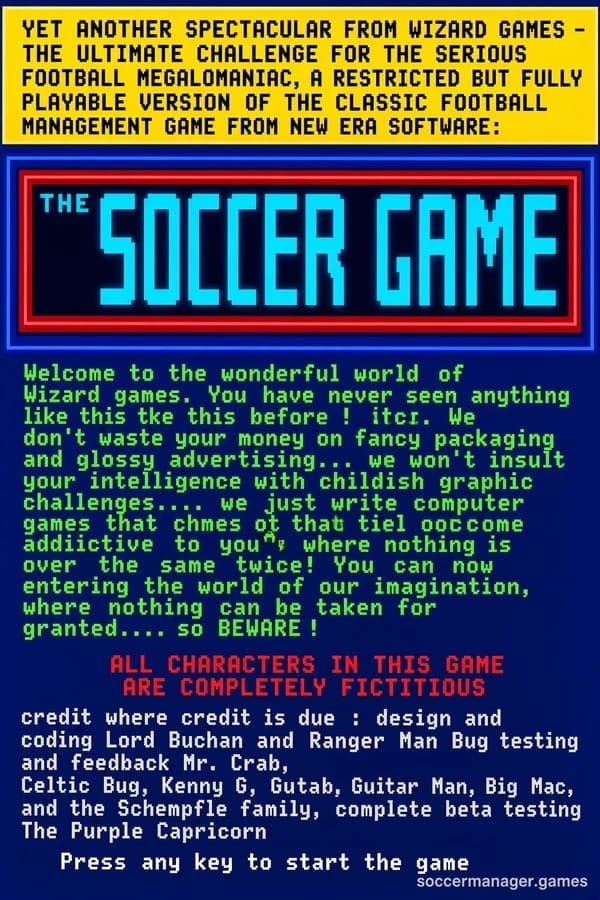
The Soccer Game treats management as a job with an employment contract. A Fourth Division club hires you for a fixed term, you cannot walk out while it runs, and when it ends you find out whether anybody else wants you: a First Division club if your record is good enough, nobody if it is not, and then the game is over. In our run, Chesterfield offered a single year.
What it does differently
Players are described in words rather than numbers. The squad screen grades skill, emotional stability, consistency and experience with terms such as Bad, Low, Fair, Good, Superb, Ace and Supremo, and the new manager at Chesterfield finds every one of his players rated Bad or Low for skill.
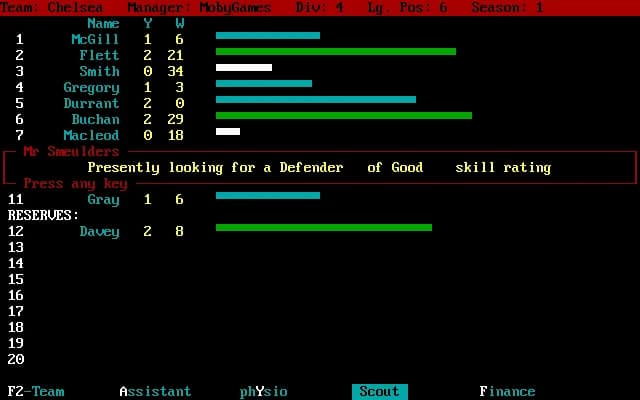
The staff do the work. The scout is told a position and a level of skill and goes looking; the help text calls him your most useful asset and declines to explain how he works. The assistant quotes the odds against you winning your next match, and the physio, the help text admits, offers a lot of useless information. Cup ties, it reckons, are usually worth a bet, and the club's shares are yours to sell, though selling too many is a sacking.
Where it shows its age
It is keyboard only, driven by highlighted letters and the cursor keys, and entirely text. Our Chesterfield started with twelve players, so the transfer market is the first stop rather than the last. Menus can be pushed aside with Ctrl and the arrow keys to see what lies beneath them, useful once you know it and baffling until then.
Worth playing?
Yes, if text does not put you off. The contract gives a career a shape, and working out the scout for yourself is a small puzzle worth having. New Era's sequel, The Soccer Game II, keeps all of this and adds a super league, stamina and a stadium to rebuild; this original is lighter and quicker to read.