
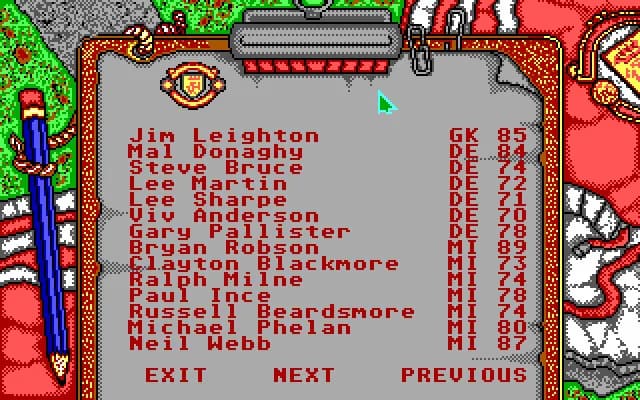
The manual opens with a potted history of the club, from the railway workers of Newton Heath through Munich and 1968 to Alex Ferguson's signings of Pallister, Ince and Webb. The game has the same priorities: it is a United product first, and the arcade match matters as much as the management.
What it does differently
Options. The question-mark icon sets the length of a match from 10 to 90 minutes, and the difficulty separately for how well the computer plays as United and as the opposition. You can switch to pure arcade, rename any player or any club in the division, and replace the default manager, Alex Ferguson.
In the arcade match you can let the computer carry out your instructions, or take over after kick-off: four arrowheads mark the man nearest the ball, a tap of fire passes along the ground, two taps chip it, and holding the button builds power. Between matches each player trains in up to four areas a week, and when a rival chairman turns up with a briefcase of money you can accept, refuse or insult him.
Where it shows its age
The mouse needs capturing with a click in the game window before the cursor moves; the arrow keys move it too. Every fixture is shown on the arcade pitch, even when the computer plays it for you, and the arcade football is basic, small sprites in sixteen colours, so set a short match length early. The management is thin: one club, seven ratings a player, and five formations, including the 2-3-5 of the 1920s. The game saves only to a team disk in drive A:; one is already in the drive here.
Worth playing?
If you remember Robson, Bruce and Webb, it is a pleasant evening: pick the side, set the training diary and play QPR yourself. As a management game it is a licence with a spreadsheet attached. For a deeper mix of office and pitch, try Gazza II.