
Teque London's manager treats you as an employee first and a tactician second. You pick a club by reading its job offer, and the manual is frank about the trade: the bigger the salary, the more the board expects, and a generous club is not necessarily one with the money to deliver.
What it does differently
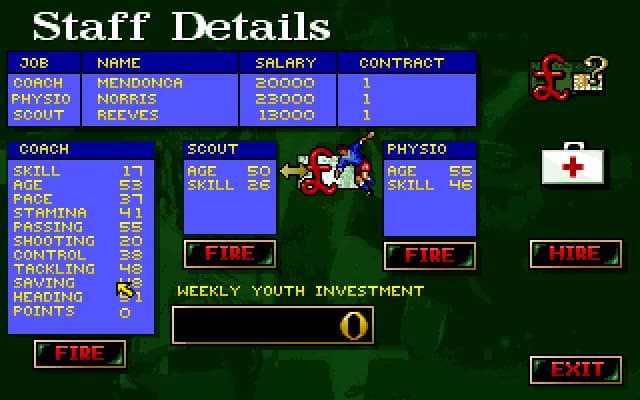
The scout matters more than usual. Before a match he shows you the opposition in the formation he expects them to use, and the manual adds, cheerfully, that he may be wrong; at half time he reports the line-up they actually played. Transfer valuations are his estimates too, so a poor scout means paying the wrong price for the wrong player.
The club side is small but real. Building work closes a stand until it is finished, so a new stand costs you gates before it earns them; the shops and the car park run on a profit margin you can push until the income falls away; and borrow too freely and the board may insist that you sell your best players. At the end of a season the job vacancies open, and the first club you took need not be the one you keep.
Where it shows its age
The first new game spends about half a minute arranging fixtures with nothing moving on screen; that is normal. Watching is a commitment: each match takes a couple of minutes, with a speed button at the top, and a week can bring more than one. The commentary repeats itself, and we saw the same player dribble forward three lines running. In the substitution list a click sometimes needs a short pause on the row before it registers.
Worth playing?
Yes, if you like seeing your team on the pitch rather than in a list; the isometric view is the reason to pick this one. Its programmer's follow-up, Club & Country, swaps the pitch for numbered dots and puts the effort into tactics and scouting instead.