
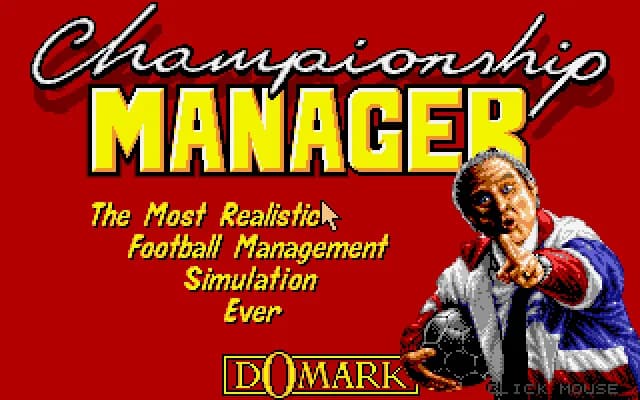
Two brothers, a bedroom in Shropshire, and a copy of BASIC. Championship Manager arrived in September 1992 with no real player names, almost no graphics and a manual that assumed you already knew what a football manager did — and it quietly rewrote what the genre was for.
What it does differently
Everything before it modelled a football club as a set of numbers you nudged. Championship Manager modelled the players. Each of the thousand-odd invented footballers in the database has attributes that interact with each other and with the tactics you pick, and the match engine resolves those interactions rather than rolling against a team rating. The consequence is the thing the series became famous for: your reserve left-back has a reason to be bad, and it is a reason you can find and fix.
There are four English divisions, a full fixture list, transfers, contracts, injuries and a board with an opinion about you. A season plays out as a column of text that scrolls past at a speed you set, and it is genuinely tense, which is not a sentence that should be true of scrolling text.
Where it shows its age
Hard, and immediately. There is no mouse-driven interface worth the name, the presentation is a monochrome menu system, and the player names are invented, so the nostalgia hit of finding a teenage Ryan Giggs in the youth team belongs to the later games rather than this one. Tactics are coarse compared with what arrived three years later in the sequel.
It is also unforgiving in a way that reads as unfair until you understand it. Nothing explains why your team is losing. The information is all there, but the game will not volunteer it.
Worth playing?
As history, absolutely — this is the point the genre turns, and it is short enough to see the whole shape of in an evening. As a game to sink a winter into, most people are better served by Championship Manager 2, which is the same idea with three more years of work in it.